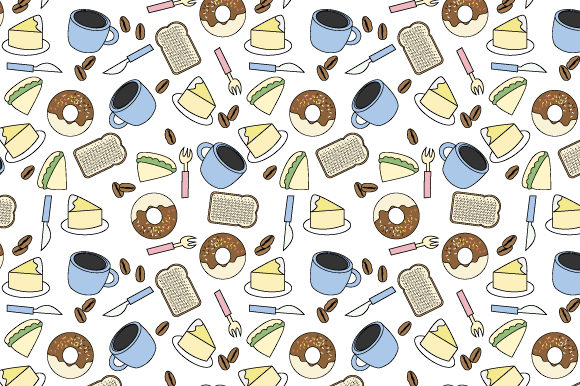
Food Doodle Seamless Pattern: Creative Design Resource
If you have ever spent hours trying to create a repeating background from scratch, you know the frustration of mismatched edges and uneven spacing. A Food Doodle Seamless Pattern solves that problem elegantly. It is a collection of hand-drawn, food-themed illustrations arranged in a repeatable tile that flows naturally across any surface. Whether you are designing packaging, building a website, or preparing classroom materials, this pattern gives you a polished, cohesive look without the tedious manual work.
The ZIP file contains three essential vector formats: SVG 1.1, Ai 10, and EPS. Each format serves a specific workflow, and having all three means you can open, edit, and scale the pattern in virtually any design application. SVG is ideal for web and digital use because it scales cleanly at any resolution. Ai and EPS formats work seamlessly in Adobe Illustrator, CorelDRAW, and other professional vector editors. This flexibility alone saves hours of reformatting and troubleshooting.
What Makes a Food Doodle Seamless Pattern Stand Out
Not all seamless patterns are created equal. A high-quality Food Doodle Seamless Pattern offers several characteristics that make it genuinely useful for real projects.
- True seamlessness: The edges match perfectly so the pattern repeats without visible lines or gaps. This is non-negotiable for professional work.
- Scalable vector graphics: Because the pattern is built with vectors, you can shrink it to fit a business card or enlarge it for a wall mural without losing sharpness.
- Editable components: In Ai and EPS formats, individual doodle elements are often grouped or layered. You can change colors, resize specific items, or remove elements entirely.
- Cohesive theme: Food illustrations feel warm, approachable, and versatile. They work well for restaurants, recipe blogs, food packaging, and educational nutrition content.
- Cross-platform compatibility: SVG works in web browsers, design software, and even text editors. Ai and EPS integrate with professional workflows. You are not locked into one ecosystem.
These qualities matter because they directly affect how quickly you can implement the pattern and how professional the final result looks. A pattern that requires constant tweaking defeats its purpose. A well-built one, on the other hand, becomes a reliable tool you reach for again and again.
Practical Applications Across Work and Life
The real value of a Food Doodle Seamless Pattern lies in its range of use cases. Here is how different professionals and creators put it to work.
Digital Content and Web Design
Bloggers and website owners often need background textures that reinforce their brand without distracting from content. A Food Doodle Seamless Pattern can serve as a subtle page background, a header overlay, or a repeating element in email newsletters. Because SVG files are lightweight, they load quickly and look crisp on retina displays. If you run a food blog or a recipe site, a pattern featuring coffee cups, vegetables, or baked goods adds personality without overwhelming your readers.
Social media managers also benefit. You can drop the pattern into Instagram story templates, create branded quote cards, or design consistent thumbnails for video series. Having one pattern that repeats across platforms builds visual recognition with your audience.
Packaging and Product Design
Entrepreneurs and small business owners who sell food products, kitchen tools, or gourmet gifts can use the pattern on labels, boxes, and wrapping paper. The vector formats allow you to adjust the pattern size to fit small stickers or large shipping boxes. Because the file includes Ai and EPS, you can recolor the pattern to match your brand palette without rebuilding the artwork.
For example, a spice company might use a Food Doodle Seamless Pattern featuring chili peppers, cinnamon sticks, and herbs on their packaging. A tea brand could use teacups and leaves. The pattern becomes a signature visual element that customers associate with your product line.
Educational and Print Materials
Teachers, educators, and homeschooling parents can incorporate the pattern into worksheets, flashcards, and classroom posters. The lighthearted food theme appeals to children and makes learning materials feel less formal. You can print the pattern as a background for menus, nutrition charts, or cooking class handouts.
Publishers and self-published authors might use the pattern as a chapter divider or decorative border in cookbooks, food journals, or lifestyle magazines. The seamless repeat eliminates awkward page breaks and gives the layout a polished, intentional feel.
Event Decor and Stationery
Event planners and hobbyists designing for parties, baby showers, or food festivals can use the pattern on invitations, placemats, banners, and table runners. Since the digital files are resolution-independent, you can print them at home or send them to a commercial printer. The pattern adds a cohesive theme to physical spaces without requiring custom illustration work.
Benefits That Go Beyond Aesthetics
Using a Food Doodle Seamless Pattern is not just about making things look good. There are practical advantages that affect your workflow and bottom line.
- Time savings: A ready-made pattern eliminates the need to design a repeating tile from scratch. You receive a tested, finished file.
- Consistency: Using the same pattern across print, web, and social media creates a unified brand experience. Your audience sees the same visual language everywhere.
- Reduced file size: Vector patterns, especially SVG, are far smaller than raster images. This means faster website loads and easier file sharing.
- Editability without loss: Because the pattern is vector-based, you can tweak colors, scale, and layout without degrading quality. This is critical when adapting assets for different formats.
- Professional polish: A seamless pattern signals attention to detail. Clients, customers, and readers notice when backgrounds look custom versus slapped together.
These benefits accumulate over multiple projects. One pattern can serve dozens of applications across months or years of work, making it a cost-effective asset.
Practical Considerations When Using the Pattern
To get the most out of a Food Doodle Seamless Pattern, keep a few practical points in mind during selection and implementation.
Check File Compatibility Before You Commit
SVG 1.1 is widely supported, but older browsers or software may handle advanced SVG features inconsistently. If you plan to use the pattern on a website, test it in your target browsers. Ai 10 and EPS are broadly compatible with current design software, but confirm that your version of Illustrator or CorelDRAW opens them correctly. Most modern applications handle these formats without issues, but a quick test saves frustration later.
Consider the Pattern Scale
A seamless pattern that looks great at one size may look cluttered or sparse at another. When applying the pattern, experiment with the tile size to match the surface. On a large banner, you might want a larger repeat so the food doodles remain visible. On a small label, a tighter repeat creates a texture effect. Vector formats make these adjustments simple because you scale the pattern without quality loss.
Customize Colors Intentionally
The original pattern may use a specific color palette. If it does not match your brand, recolor the elements in Ai or EPS. Look for patterns that use separate layers or groups for easy recoloring. This customization step makes the pattern feel like your own rather than generic clip art. Keep in mind that SVG recoloring can be done with CSS if you embed the pattern inline in a web page, giving you even more flexibility.
Use the Pattern as a Foundation, Not a Crutch
A Food Doodle Seamless Pattern works best when it supports your content, not overpowers it. Use it as a background texture, a decorative border, or a subtle accent. Pair it with clean typography and solid colors to maintain readability. The pattern adds charm, but the message and functionality of your design should stay front and center.
Recommendations for Getting Started
If you are new to working with vector patterns, start with a small, low-stakes project. Create a social media graphic or a simple flyer using the pattern to learn how it behaves in your software. Once you are comfortable, move on to packaging, website backgrounds, or larger print pieces. The three formats in the ZIP file give you room to explore without technical barriers.
Keep the original ZIP file intact as a master copy. Work on copies of the SVG, Ai, or EPS files so you can always revert to the original pattern if you need to start over. This habit prevents accidental loss of the clean, seamless tile.
Finally, look for patterns that offer a balanced composition. A Food Doodle Seamless Pattern with a nice mix of large and small illustrations, thoughtful negative space, and a cohesive color palette will serve you better than one that feels chaotic or flat. The best patterns look good both up close and at a distance, and they integrate naturally into whatever project you are building.
Whether you are a seasoned designer or a business owner handling your own creative work, having a reliable, well-formatted seamless pattern in your toolkit means one less thing to worry about. The Food Doodle Seamless Pattern with SVG, Ai, and EPS files gives you that reliability right out of the box. All that is left is to put it to use.